PestDefender ProPestDefender Pro

Bed Bug Thermal and Chemical Treatment Charleston

Bed bug thermal and chemical treatment in Charleston, SC addresses the distinct challenges of high-density hospitality properties, short-term vacation rentals, and historic residential structures. In humid…
Get My Free Estimate →(854) 260-6347
Bed Bug Thermal and Chemical Treatment in Charleston, SC
Quick answer
  • Inclusions: High-output industrial thermal convection heaters, monitored wireless thermistors, lethal heat holds past 122°F, crack-and-crevice residual insecticides, and insect growth regulators (IGRs).
  • Turnaround time: Thermal convection cycles take 6 to 10 hours for single-day eradication; chemical-only containment cycles require 2 to 3 follow-up visits spaced 14 days apart.
  • Pricing baseline: Ballpark costs range from $250 to $1,800 depending on square footage, room count, and thermal vs. chemical delivery, with exact totals confirmed during on-site assessment.
  • Targeted pests: Adult bed bugs, juvenile nymphs, and heat-resistant egg clusters hidden in mattresses, wall voids, electrical faceplates, and framing joints.
  • Scheduling: Inspections and thermal deployments are coordinated across Charleston County by calling (854) 260-6347.

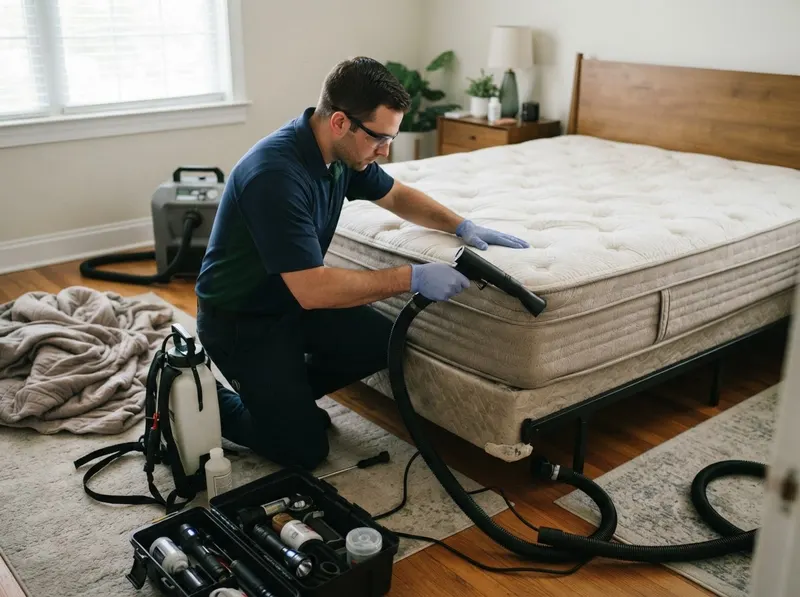
Bed bug thermal and chemical treatment in Charleston, SC addresses the distinct challenges of high-density hospitality properties, short-term vacation rentals, and historic residential structures. In humid microclimates like Harleston Village and Downtown Charleston South of Broad, ambient indoor humidity alters how insecticides bind to porous building materials, while plaster-and-lath construction creates deep harborages behind baseboards that chemical fogs cannot penetrate. Thermal remediation bypasses structural harborages by circulating dry convective air up to 122°F to 135°F using industrial heating units and axial air movers. Heat penetrates 4 inches into mattress cores, wall voids, subfloors, and upholstered furniture, coagulating insect cellular proteins and destroying bed bug eggs within a single 8-hour continuous deployment.

Chemical-only barrier treatments suit isolated, low-level introductions or multi-unit configurations where thermal containment would transfer heat into neighboring tenant spaces. Technicians inject targeted microencapsulated residual formulations and insect growth regulators directly into headboards, electrical junctions, box springs, and tack strips along perimeter flooring. In modern single-family properties across Daniel Island and West Ashley, combining localized thermal remediation with perimeter residual barriers prevents fleeing insects from entering wall cavities and establishing satellite colonies. The trade-off between protocols centers on equipment footprint versus re-entry speed: thermal protocols require removing heat-sensitive items such as candles, medications, and vinyl records but allow same-day re-entry within 2 hours of cool-down, whereas chemical protocols require negligible prep work but mandate repeat site visits across 30 days to break successive egg hatch cycles.

Historic wood framing in Wagener Terrace, French Quarter, and Hampton Park Terrace properties presents distinct structural considerations during thermal remediation. Pine subflooring and antique heart-pine moldings require slow ramp rates of 1 degree per 5 minutes to prevent wood warping while thermistors track interior cavity temperatures. On James Island, elevated crawlspaces introduce thermal sink dynamics where uninsulated floorboards draw heat downward; technicians isolate floor registers and crawlspace entry points with thermal blankets to sustain target temperatures. Every deployment follows a rigid three-step cycle: step one maps active colonies via magnified crack-and-crevice inspection; step two executes the thermal hold or precision chemical injection; step three verifies complete mortality using infrared thermal imaging and placement of active monitoring interception traps.

Bed Bug Thermal and Chemical Treatment cost in Charleston

Single Room Spot Chemical Treatment$250 - $450
Multi-Room Residual Chemical Eradication (2-3 Rooms)$500 - $850
Whole-Home Convective Thermal Treatment (Up to 1,500 sq ft)$1,100 - $1,800
Combined Heat & Residual Barrier (Large Home / Historic Plaster)$1,400 - $2,600

Every job gets a firm, written price after a free on-site visit.

Common questions

How long does a bed bug thermal treatment take in Charleston homes?
A whole-structure thermal remediation cycle in Charleston requires 6 to 10 hours from equipment setup through the required thermal hold and cool-down phase. Convection heaters elevate room temperatures between 122°F and 135°F, maintaining that threshold for at least 4 continuous hours to ensure heat penetrates thick furniture, framing voids, and floor cavities.
Can bed bugs survive chemical spray treatments in coastal South Carolina?
Certain bed bug populations in South Carolina show resistance to common over-the-counter pyrethroid sprays, which often repels insects into adjacent rooms rather than killing them. Professional chemical protocols in Charleston employ dual-action microencapsulated suspensions and juvenile hormone mimics (IGRs) that disrupt the insect chitin synthesis cycle and overcome metabolic chemical resistance.
What preparations are required before a Charleston thermal bed bug service?
Residents must remove heat-sensitive items prior to thermal deployment, including wax candles, aerosol cans, prescription medications, musical instruments, fresh produce, and vinyl records. Large furniture, bedding, clothing, and electronics remain inside the treatment envelope, as these represent the primary harborage points targeted by convective heat.
How does Charleston humidity affect chemical bed bug treatments?
High ambient relative humidity in coastal Charleston slows the evaporation rate of liquid residual sprays, requiring microencapsulated formulas that resist breakdown in damp air. In unconditioned spaces or properties with high indoor moisture, technicians apply silica-based desiccant dusts inside dry wall voids, which physically absorbs the insect's protective waxy outer layer regardless of ambient humidity.
How soon can guests or tenants return to a treated Charleston property?
Properties undergoing thermal treatment permit human and pet re-entry approximately 2 hours after equipment shutdown, once interior air temperatures drop below 85°F. Properties undergoing liquid chemical treatments require a mandatory 4-hour re-entry clearance window to allow applied residual barriers to dry completely along baseboards and structural junctions.
Helpful resources

Trusted references & local links

USA.gov, government & consumer helpBetter Business BureauFTC Consumer AdviceU.S. Small Business AdministrationReady.govU.S. EPAENERGY STARU.S. Dept. of EnergyConsumer.govU.S. Census BureauGoogle Maps, Charleston, SC

Get started today

Tell us about your bed bug thermal and chemical treatment job in Charleston and we'll send a clear, written quote, usually the same day.
Get your free Pest Control Service quote, Charleston

We only use your ZIP to check availability, no spam.